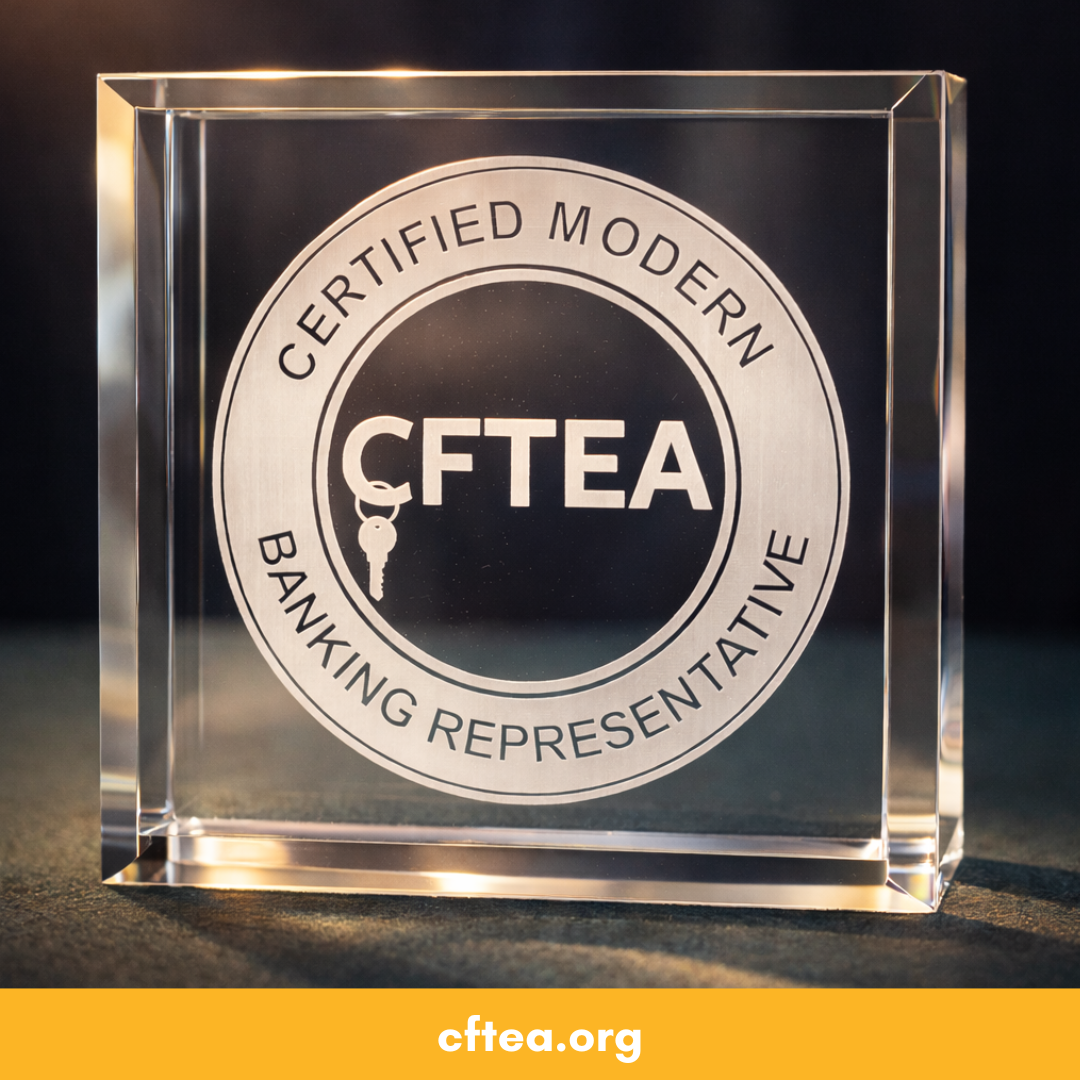
CFTEA

Certified Modern Banking Representative, CEUs

$519.00

Description

Online Certified Modern Banking Representative Certificate

 Estimated length: 18 hours
 Access Time: 365 days
 1.6 CEUs

Certificate Description

As a modern certification in today’s business world, the Certified Modern Banking Representative (CMBR) covers updated material that allows new, entry-level employees to develop in their careers and equips them to take on modern banking challenges with knowledge, confidence, and skill. This is an entry-level certification for banking representatives that applies to a broad group of job seekers. Certification can offer a clear pathway to employment in the banking industry.


Upon successful completion of all courses in this certificate program, you can download and print a Certificate of Completion.


Courses included in this certificate program are listed at the bottom of this page.


Key Features

  •  Expert-supported
  •  Mobile-friendly
  •  Accessible
  •  Badge and credit-awarding
  •  Games & Flashcards
  •  Video content
  •  Real-world case studies
  •  Audio-enabled in app


Notes

All courses in this certificate have an “Ask the Expert” feature, which submits your questions directly to an expert in the field you are studying. Questions are answered as quickly as possible and usually within 24 hours.


This course does not require any additional purchases of supplementary materials.


Learners must achieve an average test score of at least 70% to meet the minimum successful completion requirement and qualify to receive IACET CEUs. Learners will have three attempts at all graded assessments.

Courses included in this suite

Banking Today

 Estimated length: 4 hours
.4 CEUs
Financial institutions are unlike any other business. To someone new to the world of banking, it can seem puzzling. However, financial institutions play a key role in maintaining thriving communities and economies. The welfare of the nation depends on the banking industry. In this course, learners will examine types of banking, customer groups, the business of banking, and the role of banks in a community.

Learning Outcomes

  • Explain how employees, customers, and the community benefit from a financial institution
  • Provide insight into the economy of banking
  • Understand banking innovations and their impact on your organization
  • Understand how a financial institution displays profitability
  • Explain how organization structures differ within financial institutions and how the board, officers, and employees contribute to expanding relationships
  • Describe the methods used to safeguard banking relationships and funds

Certified Modern Banking Representative Exam

Estimated length: 2 hours
This course contains the Center for Financial Training & Education Alliance’s (CFTEA) online exam for the Modern Banking Representative Certification (MBRC). As a modern certification in today’s business world, the nationally accepted MBRC covers material designed to provide relevant knowledge to new and entry-level employees as they develop and advance in their professional careers at financial institutions.

Fighting Fraud:  Top Ten Scams Targeting Our Nations Seniors

Estimated length: 2 hours
.2 CEUs
Banking representatives play a key role in combating financial fraud and educating consumers about potential scams. In this course, learners will become familiar with the most common types of financial fraud scams, how to identify them, and how to report them.

Legal Foundations in Banking

 Estimated length: 4 hours
 0.4 CEUs
As a vital part of the U.S. economy and a necessity for most Americans, the banking industry is subject to extensive regulation, and banking professionals must understand the legal and ethical responsibilities that come with their work. This course introduces learners working toward Modern Banking Representative Certification to the basics of banking law, exploring the agencies that regulate banking in the U.S. and the various federal laws that affect banking professionals’ daily operations.

Learning Outcomes

  • Outline the responsibilities of the federal agencies that regulate banking in the U.S.
  • Summarize federal laws that significantly impact the U.S. banking industry
  • Apply principles of ethical conduct in daily banking operations
  • Understand the function of appraisals in banking
  • Explain the basic structure of a contract and the significance of a breach of contract
  • Explain the mechanisms behind checks and other negotiable instruments
  • Identify the rights and responsibilities of bank account holders based on the titling of the account in question
  • Explain the responsibilities of banks in combating financial crime
  • Evaluate the potential impact of operations on a bank’s reputation

Quality Service

 Estimated length: 6 hours
0.6 CEUs
Service representatives often act as the “face” of their organizations and play a critical role in delivering the best experience for every customer. In this course, learners will explore theories, strategies, and techniques for delivering quality service and building customer loyalty. This course is designed for service professionals with any level of experience who want to expand their knowledge, improve their skills, and increase their understanding of customer service.

Learning Outcomes

  • Describe the benefits of providing quality customer service, identify internal customers, and identify how to help organizations excel
  • Apply best practices in customer service and employ the criteria required for a satisfactory customer experience
  • Describe the external and internal factors in a customer’s experience and how these relate to the Voice of the Customer
  • Identify the benefits of bringing respect, emotional support, and a personal touch to customer interactions, and apply these practices to customer interactions
  • Differentiate between and recommend key performance indicators (KPIs) to enhance the customer experience
  • Identify different types of face-to-face communication, the critical success factors in face-to-face communication, and the benefits of actively listening to customers
  • Identify various remote customer service communication channels, e.g., online, phone, etc., and apply best practices for each channel
  • Take action to increase the loyalty of the customers served
  • Identify the benefits of customer complaints, the steps in the service recovery process, and analyze the moments of truth in real-life situations
Code: M5061SP
Signup for our newsletter and be the first to know about new courses and discounts:
  • This field is for validation purposes and should be left unchanged.